Real-world threat library
Test against 30,000+ TTPs and thousands of threat scenarios, from ransomware to APTs, maintained by Picus Labs under a 24-hour SLA for critical threats.

Continuously validate your live defenses against real attacks:
See what your EDR, SIEM, NGFW, WAF, email gateway and other controls block, detect, log, and miss.
Close real gaps with ready-to-deploy, vendor-specific fixes, then re-test to confirm.
Stay ready as threats, controls, and configurations change.
Adversaries now weaponize new CVEs in hours, probe your environment at machine speed, faster than teams can manually tune controls, update detections, or validate coverage.
In the post-Mythos era, readiness has to be proven continuously against the threats, techniques, and configurations changing around you.
Security controls drift. Detection rules age. Exceptions accumulate. New attacker techniques appear faster than most teams can test.
Picus closes that gap by continuously validating real adversary techniques against your live controls, including EDR, SIEM, firewall, and email security. When a control fails, Picus provides a vendor-specific fix and lets you re-run the same simulation to prove the gap is closed.
control effectiveness within 3 months
reduction in MTTR for emerging threats
to create and simulate new attacks with AI
integrations across your security stack
The threats moved to machine speed. Validation has to match them, with the judgment, traceability, and control that enterprise security demands.
Picus AI Threat Builder turns unstructured intelligence, a blog URL, a PDF, a CVE ID, or a threat-actor name, into a fully playable, ATT&CK-mapped simulation. About 9 minutes on average, so validation keeps pace with the speed of disclosure .
Picus Swarm is a swarm of AI agents synthesizes signals, crafts adversary-informed simulations, validates your defenses, and mobilizes the fix in one unbroken loop. It is autonomy with a chain of custody: every action traceable, every agent bound to your rules, tunable from fully supervised to fully autonomous.
Picus is verified under Anthropic's Cyber Verification Program, the pathway that extends frontier-class cyber capability to defenders. That verified access is what powers Picus AI capabilities.
Test against 30,000+ TTPs and thousands of threat scenarios, from ransomware to APTs, maintained by Picus Labs under a 24-hour SLA for critical threats.
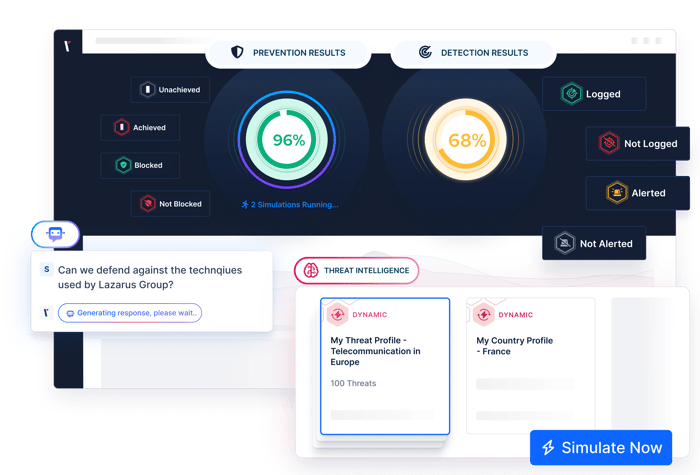
Every gap ships with ready-to-deploy prevention signatures and detection rules for the tools you run, then re-runs the same attack to confirm closure.
Results map automatically to the ATT&CK matrix, so you can see coverage and gaps at a glance and prioritize the techniques that pose the greatest risk.
Automated reports and custom dashboards track readiness and performance trends over time, keeping stakeholders across the business informed.
Compare your scores against industry peers, regional counterparts, and the Picus community to see where you stand and prioritize accordingly.
With the Picus Threat Builder, chain attack actions and upload custom payloads to test bespoke scenarios, no red-teaming expertise required.
30,000+
TTPs and threat scenarios in the Picus Threat Library
75+
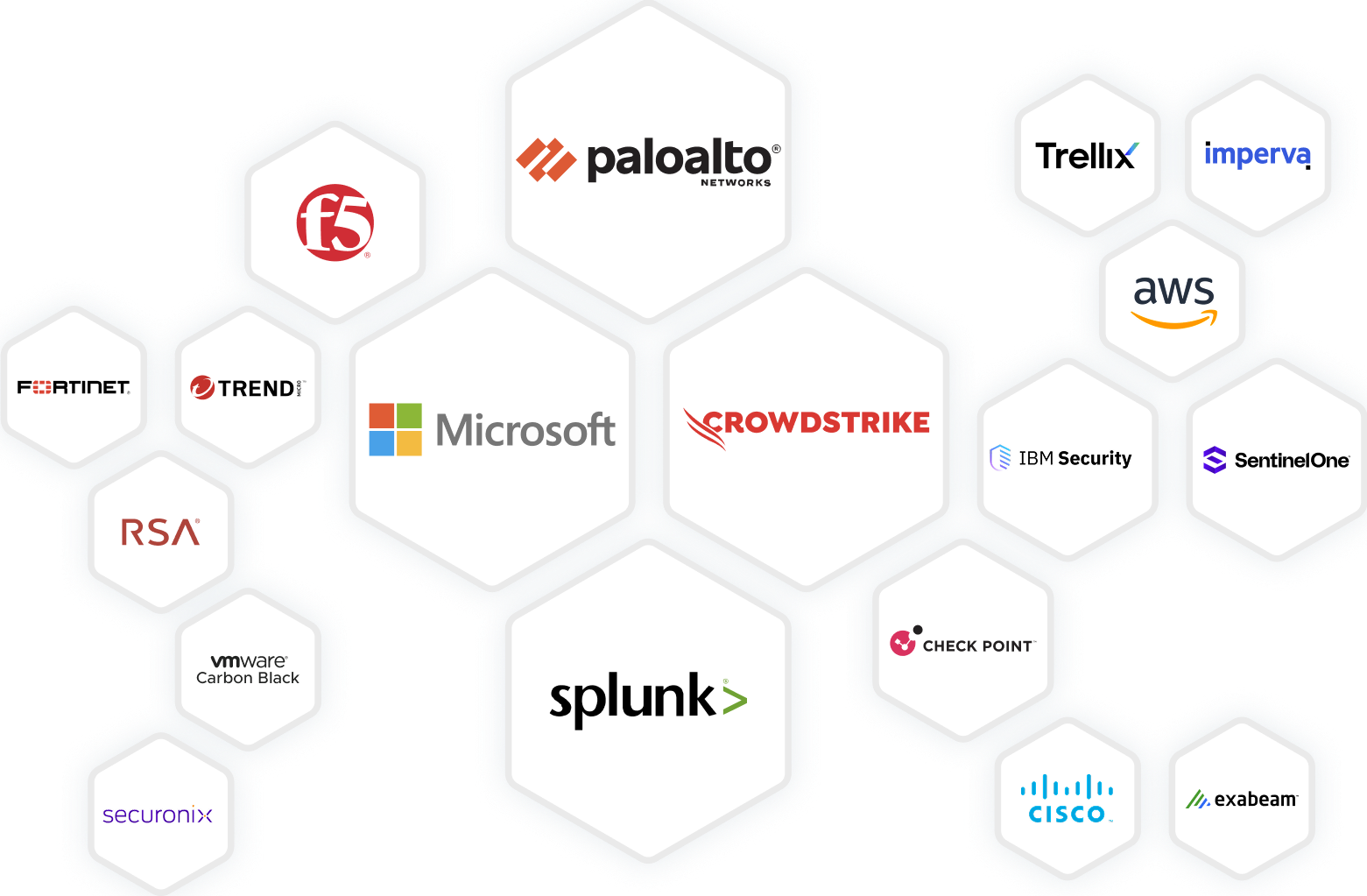
Integrations across EDR, SIEM, NGFW, WAF, and email
24hr
SLA for adding simulations for critical new threats
~9min
Average to turn threat intel into a runnable simulation
Two continuously maintained libraries do the heavy lifting: one to attack with, one to defend with.
Get actionable mitigations for emerging threats, including vendor-specific prevention signatures and detection rules ready to deploy, then re-validate to confirm closure.
Picus tests your controls against a regularly maintained library of thousands of real-world threats and attack actions, across every layer of your stack.
See what your WAF stops, and what it can't, against the techniques attackers aim at your apps.
COVERAGE INCLUDES
OWASP TOP 10, SQL injection, XSS, XXE, command injection and RCE, SSRF, path traversal, authentication bypass, webshells, and WAF bypass techniques.
See what your network security controls catch, and what moves through undetected.
COVERAGE INCLUDES
APT-group network traffic, ransomware delivery, malware loaders and droppers, infostealers, remote access tools, and vulnerability exploitation traffic.
See what your endpoint controls catch across a full attack, and what they can't, not just isolated samples.
COVERAGE INCLUDES
APT, ransomware, malware campaigns, full kill-chain scenarios, MITRE ATT&CK techniques, fileless and in-memory execution, and living-off-the-land techniques.
See what your DLP stops, and what sensitive data can still leave undetected.
COVERAGE INCLUDES
Exfiltration of PII, PCI, and PHI, source code and secrets, intellectual property, and country-specific regulated data, across different file formats and channels.
See what your email gateway blocks, and what reaches the inbox.
COVERAGE INCLUDES
Phishing links, malicious attachments and weaponized documents, malicious macros, executable malicious code, malware droppers and loaders.
See what your web gateway blocks, and what outbound traffic still gets through.
COVERAGE INCLUDES
Outbound requests to malicious domains and URLS, malware and ransomware download sites, phishing pages, and malicious command-and-control sites.
Identify what your NGFWs, WAFs, EDRs, SIEMs, and other security controls are missing.
Fine-tune controls using vendor-specific and agnostic mitigation guidance and detection rules.
It allows me to test current cyber attack scenarios within my own environment, which is extremely valuable for improving our security posture.
Manager, IT Security and Risk Management, IT Services
Clear metrics, great outputs for reporting C-Level; measurable risk drop. Optimization by focusing patching efforts on assets that truly present risk.
CISO, Banking
The vendor provides quick customer support and the technical sales team and support team has been fantastic.
Engineer, Consumer Goods
A very successful platform where we can test the accuracy of our security investments and see their scores.
Manager, IT Security and Risk Management
Picus is one of the best BAS solution on the market today. The threat database it is constantly updated.
ICT Security Engineer, Oil and Gas
Picus completes the task it is required to do near perfect as a BAS solution. Threat database is up to date & updated frequently after a new malware or campaign, also the database is large.
Consultant Security Engineer, Telecommunications
There is a very nice team from which I can get quick support. The application provides us with great convenience and confidence in our work.
Information Security Specialist, Healthcare
To test our systems with the real-time attack product is helping us to improve our security maturity. At the same time, the real time attacks are updating with the zero-day vulnerabilities.
Senior Vulnerability Management Engineer, IT Services
With the help of this product we can perform continuously endpoint attack via latest tactics and techniques which are used by threat actors.
Manager, IT Security and Risk Management, IT Services
It is possible to customize the campaign or schedule the assessment periodically, to test protection measure implemented on network, endpoint and email.
ICT Security Engineer, Manufacturing

Breach and Attack Simulation is one part of the Picus Platform. Together, these capabilities converge into one continuous validation loop, from attack surface to controls to exploitable exposures.
In a live demo, watch Picus validate a real exposure end to end, from exploit to fix to re-test.
Simulate real-world cyber threats in minutes and see a holistic view of your security effectiveness.
Breach and Attack Simulation (BAS) is a technology that safely and continuously emulates real adversary techniques against your security controls to measure how they perform. It enables security teams to understand whether the tools they use to prevent and detect threats are functioning as expected, so they can address any gaps and achieve the best possible protection and value from their investments. Picus pioneered BAS and has spent 10+ years advancing it.
BAS is essential because it helps security teams identify policy weaknesses that could let attacks go unprevented and undetected. It ensures defenses are optimized against evolving threats and that misconfigurations resulting from infrastructure drift are addressed before breaches occur.
BAS should be performed on a regular basis to ensure prevention and detection gaps are identified and addressed swiftly. Automated security validation with BAS augments manual approaches such as pentesting, enabling security teams to identify policy weaknesses continuously rather than at a single point in time.
Yes. Picus BAS is designed to validate security controls safely in production without disrupting users, systems, or business operations. You gain evidence of real defensive effectiveness from live environments while maintaining operational stability.
By continuously testing and helping improve the effectiveness of security controls, Picus BAS helps organizations comply with a wide range of regulations and standards. Laws such as GDPR state that organizations should have a process for regularly testing, assessing, and evaluating the effectiveness of technical and organizational measures. ISO 27001 and PCI DSS, as well as frameworks such as NIST 800-53, have similar requirements.